
Inventory Management Blog
Expert perspectives on inventory, supply chain and operational excellence to help your business work smarter,
reduce costs and grow sustainably.
Slow-Moving and Non-Moving Inventory: How to Identify and Manage It
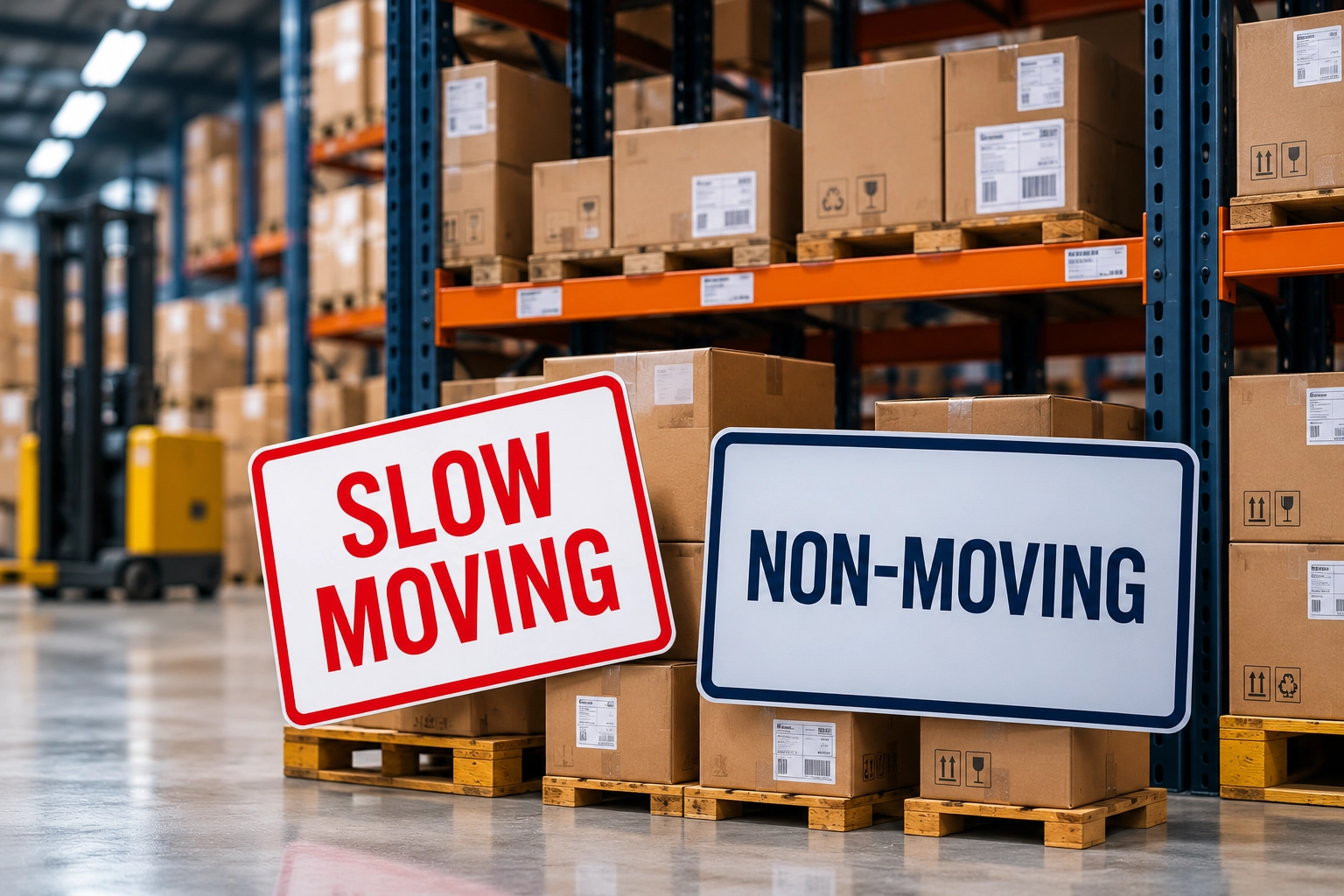
Slow-moving and non-moving inventory can quietly absorb working capital while receiving little management attention. Products may remain in stock long after demand has weakened, often without becoming visible as a priority until the financial impact is significant.
Identifying these items early is therefore an essential part of effective inventory management. The sooner potential issues are detected, the more options a business has to take action and reduce the impact on cash flow, storage costs and overall profitability. Early visibility also gives management more time to decide whether stock should be retained, redeployed, discounted or liquidated.
What is slow-moving inventory?
Slow-moving inventory consists of products that continue to sell or be consumed, but at a significantly lower rate than expected.
Non-moving inventory has recorded no movement for a defined period.
The distinction matters because the appropriate management action may be different. For management, the priority is to recognise weakening movement early enough to intervene before stock becomes a long-term cash and storage burden.
Why businesses miss the problem
Many organisations can tell management the total value of inventory but cannot immediately answer:
Which products have had no movement for the last 180 days; for example.
If answering that question requires several spreadsheets, manual consolidation or investigation across multiple systems, management may discover the problem only after significant working capital has already been trapped.
Measure movement, not just stock
Simply identifying a high stock quantity is not enough.
A high-volume fast-moving item may legitimately have substantial inventory. A product with a relatively small quantity but zero demand may represent a much greater inventory risk.
Why does inventory stop moving?
Common causes include:
- inaccurate forecasts;
- changes in customer demand;
- discontinued products;
- excessive purchasing;
- minimum-order quantities;
- new-product launches that underperform;
- duplicated SKUs;
- assortment changes;
- poor replenishment parameters;
- inventory located where demand does not exist.
Create an exception-based process
Management should not need to manually examine every SKU.
That converts inventory reporting from an accounting exercise into an operational management process.
Don’t just dispose of the stock
Markdowns and liquidation can release working capital, but the bigger question is:
Why did the business create the non-moving inventory in the first place?
Unless purchasing, forecasting, assortment or replenishment decisions change, today’s clearance exercise becomes tomorrow’s inventory problem.
Free Inventory Health Check
Not sure how effectively your business identifies non-moving inventory? Take the Free Inventory Health Check and receive an immediate score and recommendations.
Pingback: Why Stockouts Happen — and How to Reduce Them Without Increasing Inventory » ijcne.com
Pingback: Ageing Inventory: How to Identify It, Measure It and Reduce It » ijcne.com
Pingback: Framework: for leveraging Supply Chain Planning for Cash Flow Management » ijcne.com